By Shash7. Posted under guides Posted on 20th May, 2026 - Updated on 20th May, 2026
By Shash7. Posted under guides Posted on 20th May, 2026 - Updated on 20th May, 2026

Researching competitor ads is one of the fastest ways to improve your own campaigns without burning budget on random testing.
Your competitors are already spending money to test hooks, offers, formats, and angles. If you study those ads properly, you can skip weak ideas and start from what is already working.
In this guide, I'll show you how to spy on competitor ads using ad libraries, why Facebook Ad Library is still the best place to do it, and how to use Swipekit to run this on autopilot.
Contents
Most brands fail because they guess too much.
Competitor ad research fixes that by giving you live market signals:
If the same advertiser keeps running a similar creative angle for weeks, that usually means the ad is profitable. That gives you a direction to test instead of starting from zero.
Here's an example workflow I'd run.
Start with 3-4 brands in your category. Mix direct competitors with one or two bigger brands you want to learn from.
Look for active ads first. These are usually the most useful because they reflect what is currently being funded.
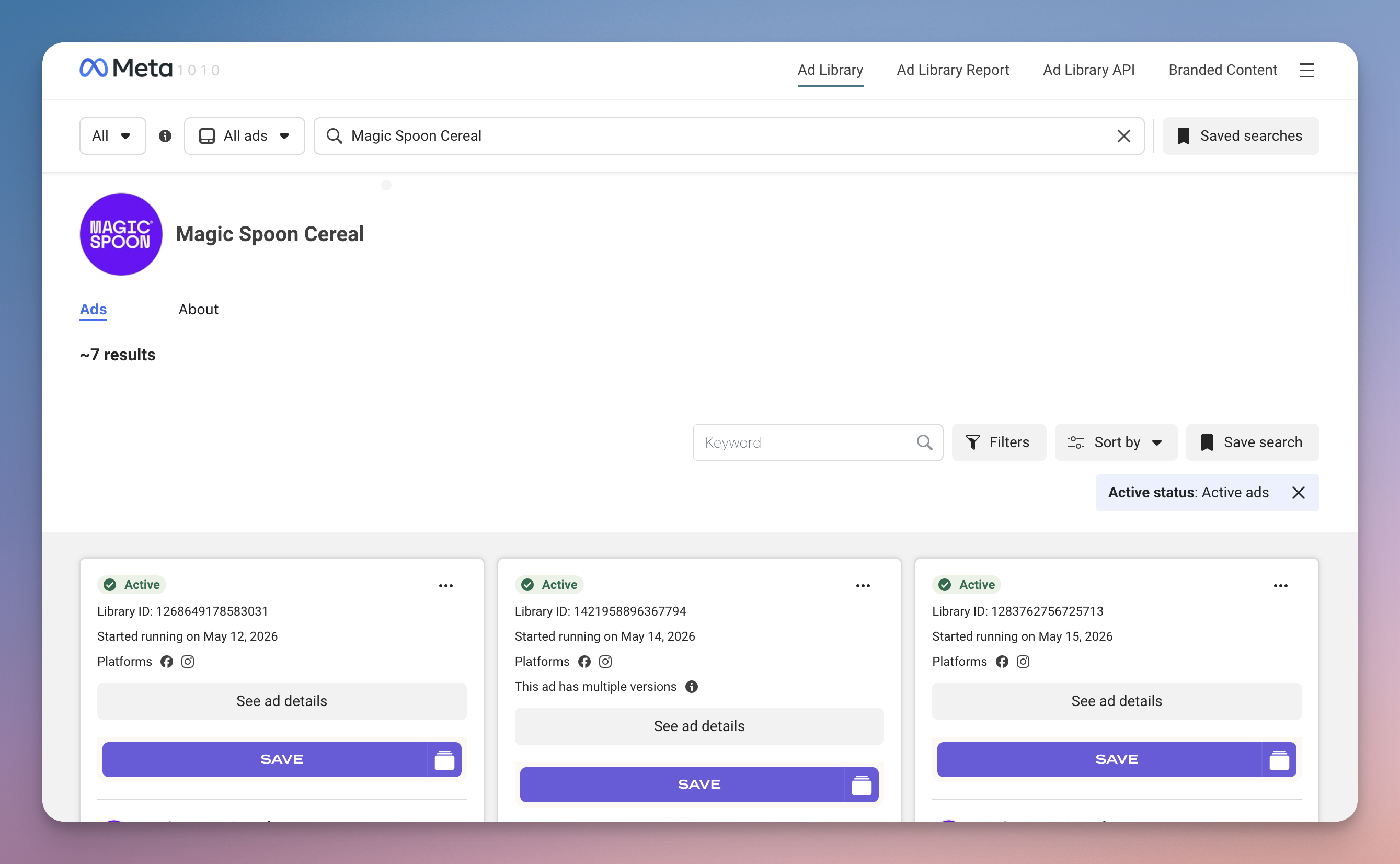
Use filters for:
For each ad, capture:
One ad means nothing. Repeated patterns across multiple ads usually indicate a real strategy.
Translate your observations into test ideas your team can launch fast.
Example: "3 competitors are using founder-story UGC with problem-first hooks. Test 2 variations this week."
There are multiple ad libraries out there, but Facebook Ad Library is still the best overall source for competitor research.
Here's why:
If your goal is practical competitive intel for day-to-day campaign work, Facebook Ad Library gives the best signal-to-noise ratio.
Manual ad research works, but it gets messy fast. You open too many tabs, links expire, creatives get lost, and nobody on the team can find insights later.
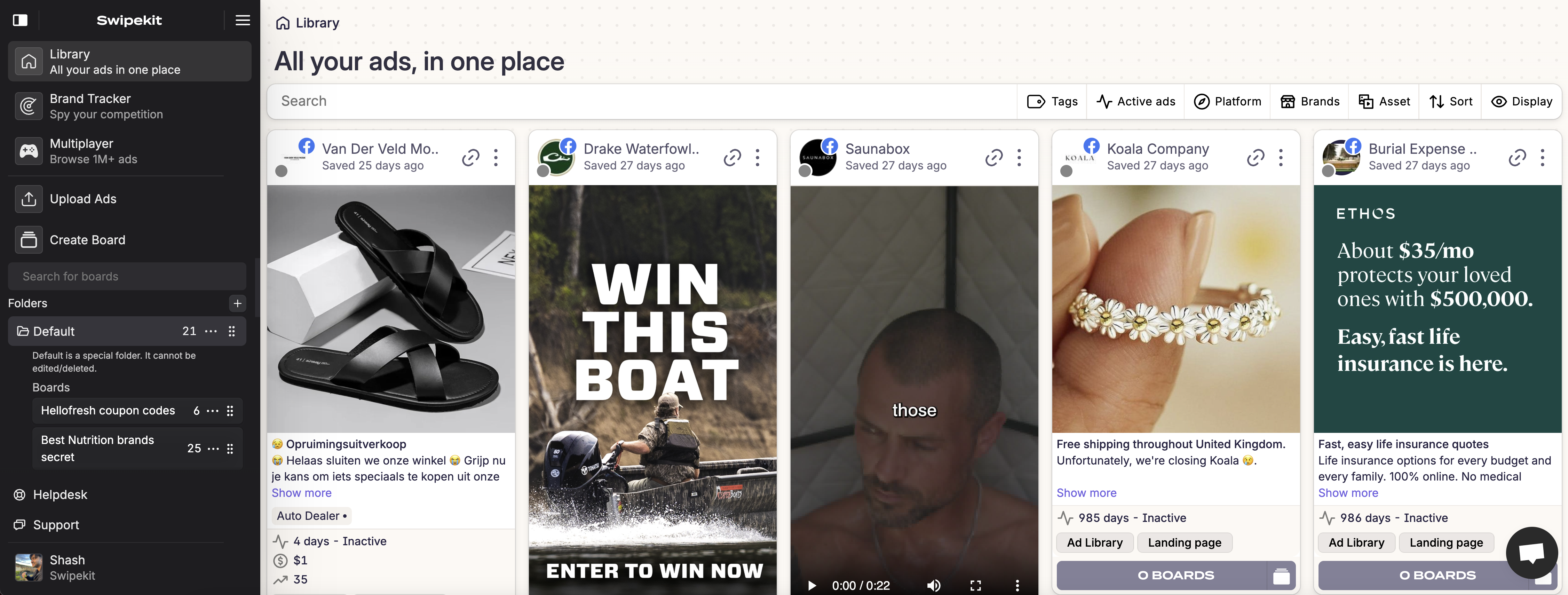
Swipekit solves that workflow problem.
Here's a simple autopilot setup:
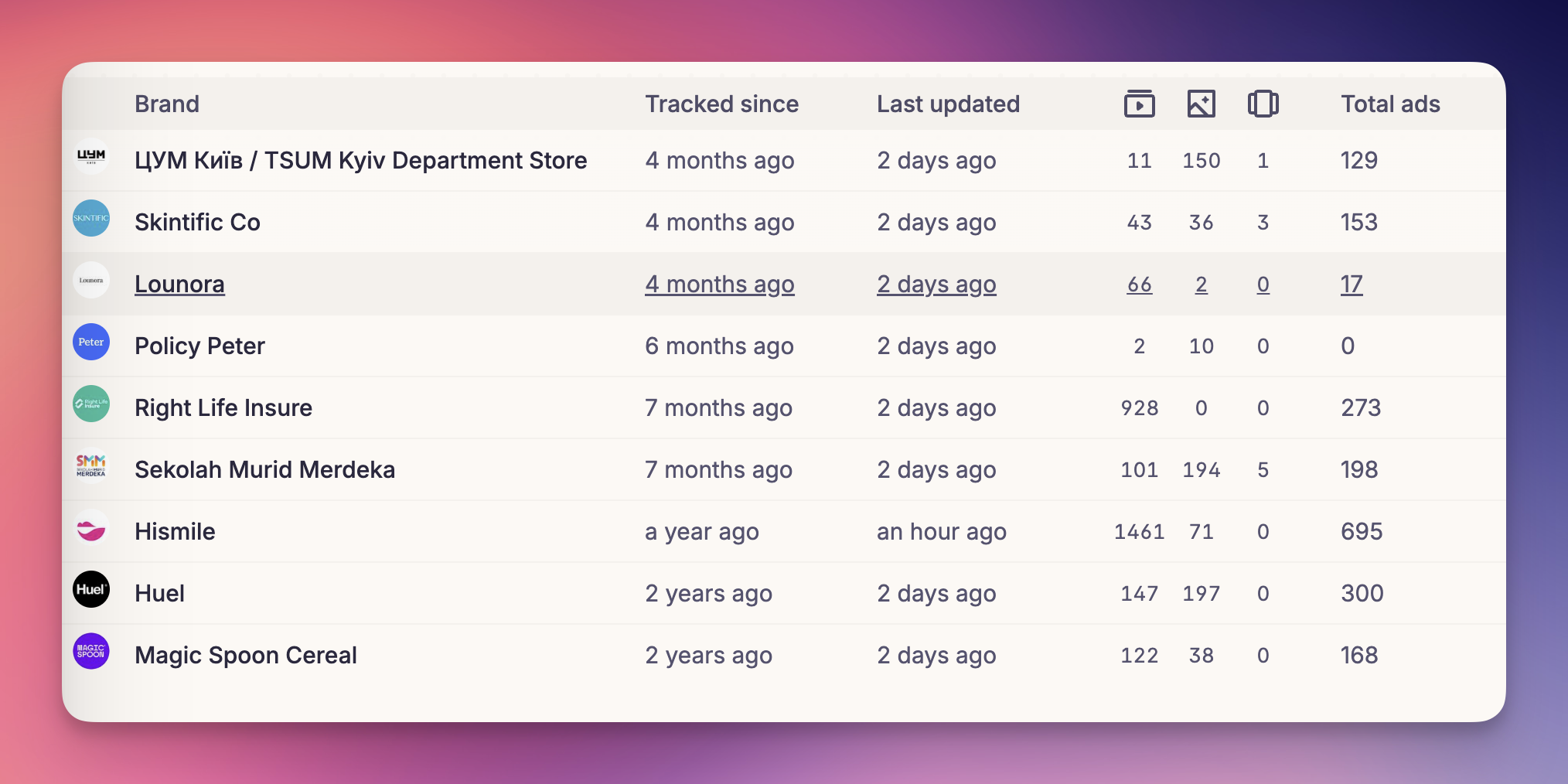
This is where things get very interesting.
With Swipekit MCP, you can ask strategy questions directly from your chat app and get fast summaries based on the competitor ads you are tracking.
That means less manual analysis and faster decisions.
Example prompts you can use:
Show me the top recurring hooks used by [Competitor Name] in the last 30 days from Facebook Ad Library ads saved in Swipekit.
Compare offer strategy changes between [Competitor A] and [Competitor B]. Focus on discount framing, urgency language, and CTA shifts.
Based on tracked ads, what audience signals can we infer from creative style, copy tone, and landing page intent?
Summarize the 5 most likely winning angles we should test this month and map each to a creative brief.
In plain terms, Swipekit MCP helps convert raw competitor ad data into usable strategy:
Competitor ad research helps reduce guesswork and increase your hit rate.
Use ad libraries to watch the market, use Facebook Ad Library as your primary source, and use Swipekit to automate tracking so insights don't get lost.
Then layer Swipekit MCP on top from your chat app to quickly decode competitor strategy and turn it into better briefs, faster experiments, and stronger campaigns.
Save winning ads from every major library, keep the full context, and turn scattered inspiration into reusable creative direction.
Start free trial

AG1 by Athletic Greens
Meet Your New Supplement Routine ✅

Feel Reformed

Upgrade your Matcha


HEC Wellness Center
AG1 by Athletic Greens
Meet Your New Supplement Routine ✅
Feel Reformed
Upgrade your Matcha
HEC Wellness Center
 Try Swipekit